

How Cobalt blue is made:
| In the lab | |
| Materials needed: | Aluminum chloride AlCl3, Cobalt(II)-chloride CoCl2 · 6H2O |
| Safety (MSDSs): | Cobalt(II)-chloride, Aluminum chloride (at Fisher Scientific) |
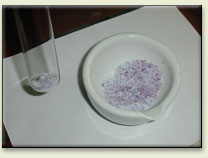
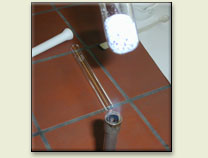
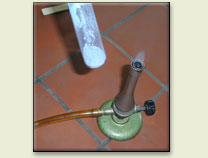
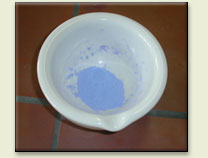
| Method: | 1 g Cobalt(II)-chloride (CoCl2 · 6H2O) and 5 g Aluminum chloride are homogenized in a mortar and heated in a test tube with a gas burner for about 3 to 4 minutes. |
Illustration of the process:
making cobalt blue in the laboratory:
 |
 |
|
|
|
 |
 |
|
|
|
The ground pigment:
Pile of ground Cobalt blue

Other blues
(intro) - Azurite - Cerulean Blue - Cobalt blue - Egyptian blue - Prussian blue - Smalt - Ultramarine
(intro) - Azurite - Cerulean Blue - Cobalt blue - Egyptian blue - Prussian blue - Smalt - Ultramarine
 Sections: