

How Prussian blue is made:
| Artificial variety of pigment | Precipitation from the solution of potassium ferrocyanide by a more saturated solution of iron(III)-chloride. The combination of the ferric ion (from the chloride) and ferrocyanide creates the pigment, the two irons have to be in different oxidation states (ferric vs ferrous). |
| 19th century recipe | Dissolve sulphate of iron (copperas, green vitriol) in water; boil the solution. Add nitric acid until red fumes cease to come off, and enough sulphuric acid to render the liquor clear. This is the persulphate of iron. To this add a solution of ferrocyanide of potassium (yellow prussiate of potash), as long as any precipitate is produced. Wash this precipitate thoroughly with water acidulated with sulphuric acid, and dry in a warm place. |
| In the lab | |
| Materials needed: | potassium ferrocyanide and iron(III)-chloride. |
| Safety (MSDSs): | Iron(III) chloride, potassium ferrocyanide (at Fisher Scientific) |
| Method: | A solution of 2 g FeCl3 in 100 ml deionized water is slowly poured into a stirred solution of 1 g K4[Fe(CN)6] in 200 ml deionized water. The blue precipitate is filtered and dried at elevated temperature (c. 100°C) |
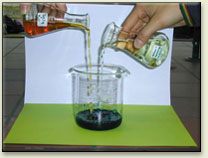
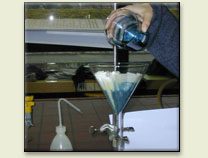
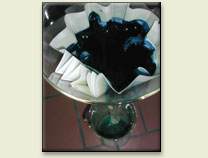
Illustration of the process:
Making prussian blue in the laboratory:
 |
||
| Solutions of potassium ferrocyanide and iron(III) chloride are poured together | ||
|
|
||
 |
 |
|
| Filtration of the resulting precipitate of the pigment prussian blue | ||
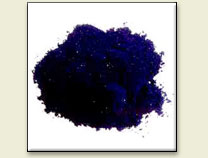
The ground pigment:
Pile of ground Prussian blue
Other blues
(intro) - Azurite - Cerulean Blue - Cobalt blue - Egyptian blue - Prussian blue - Smalt - Ultramarine
(intro) - Azurite - Cerulean Blue - Cobalt blue - Egyptian blue - Prussian blue - Smalt - Ultramarine
 Sections: