

How Ultramarine is made:
| Origin: natural and artificial | Lapis lazuli is a complex rock mixture containing the mineral Lazurite (at Mineralogy Database) |
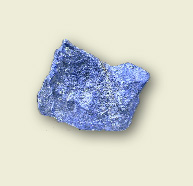 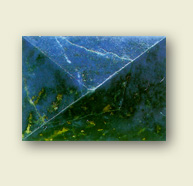  Views of the mineral lazurite |
|
| Natural variety of pigment | Natural ultramarine is purifed from ground lapis lazuli by mixing it with wax and kneading in a dilute lye bath. The brilliant blue lazurite crystals preferentially wash out and are collected. |
| Artificial variety of pigment | Artificial ultramarine, also known as French ultramarine was made by heating, in a closed-fire clay furnace, a finely ground mixture of China clay, soda ash, coal or wood, charcoal, silica and sulfur. The mixture was maintained at red heat for one hour and then allowed to cool. It was then washed to remove excess sodium sulfate, dried and ground until the proper degree of fineness was obtained |
| 19th century recipe | Natural ultramarine
Separate the blue parts, and reduce them, on a piece of porphyry, to an impalpable powder, which besprinkle with linseed oil, then make a paste with equal parts of yellow wax, pine resin, and colophonium, say, 8 oz. of each; and add to this paste 1/2 oz. of linseed oil, 2 oz. of oil of turpentine, and as much more mastic. Then take 4 parts of this mixture, and 1 of lapis lazuli, ground with oil on a piece of porphyry, mix the whole warm, and suffer it to digest for a month, at the end of which knead the mixture thoroughly in warm water, till the blue part separates from it, and at the end of some days decant the liquor. This ultramarine is exceedingly beautiful. Synthetic ultramarine Sulphur, 2 parts; dry carbonate of soda, 1 part. Put them into a Hessian crucible, cover it up, and apply heat until the mass fuses, then sprinkle into it gradually a mixture of silicate of soda and aluminate of soda (the first containing 72 parts of silica, the second, 70 parts of alumina); lastly, calcine for 1 hour, and wash in pure water. |
Illustration of the process:
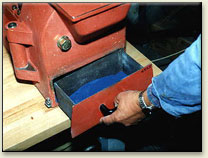
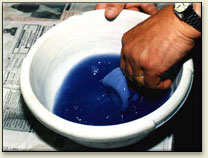
Preparing natural ultamarine at Kremer Pigments
 |
 |
|
| The mineral is first ground in an electric mill | The fine particles are mixed with alcohol and poured over magnetized channel to remove the magnetic pyrite particles | |
|
|
||
 |
 |
|
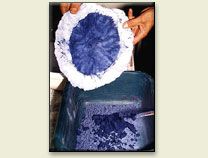
| The resulting mass is kneaded with wax and water and pressed through fine cloth. The less valuable coarse "ultramarine ash" stays in the cloth | The finest pigment particles pass through the cloth and constitute the highest quality ultramarine | |
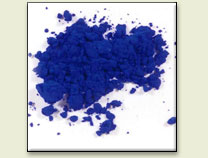
The ground pigment:
Pile of ground Ultramarine
(intro) - Azurite - Cerulean Blue - Cobalt blue - Egyptian blue - Prussian blue - Smalt - Ultramarine
 Sections: