

How Indigo is made:
| Origin: plant | Plants: woad (Isatis tinctoria L.), Indigofera tinctoria L. and others |
The most typical source of indigo is woad, shown in this field. Today, indigo is also produced by the bacterium E. coli through genetic engineering: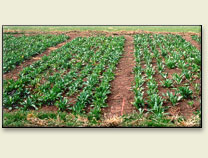 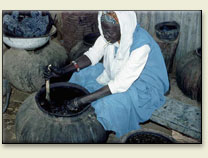 Indigo is most commonly used as a dye for fabrics, as this woman is doing (Podor, Senegal). To make painting pigments, the dye is "fixed" to a ground white material, in a processed called "laking." The four panels below depict the traditional process of indigo manufacture in India. Clockwise starting at top left, beating by machinery; "rahut," or Persian wheel; straining the indigo; press and boiling house. |
|
| Natural variety of pigment | To prepare the dye, freshly cut plants were soaked until soft, packed into vats and left to ferment. It was then pressed into cakes for use as a watercolor or dried and ground into a fine powder for use as an oil paint.. |
| In the lab | |
| Materials needed: | o-Nitrobenzaldehyde, acetone, sodium hydroxide |
| Safety (MSDSs): | o-Nitrobenzaldehyde, acetone, sodium hydroxide (at Fisher Scientific) |
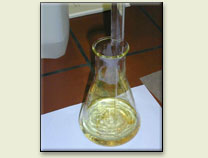
| Method: | 4 g o-nitrobenzaldehyde is dissolved in 40 ml acetone using a 200 ml erlenmeyer flask. 20 ml deionized water are then added and the flask is shaken thoroughly. Next, 16 ml of a 1 molar solution of sodium hydroxide is added slowly. The mixture is stirred with a glas rod and left standing for five minutes. The precipitated indigo is then filtered off and dried at room temperature. |
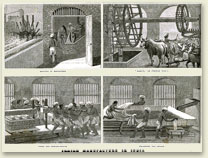
Illustration of the process:
Making indigo in the laboratory
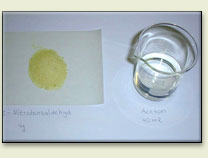
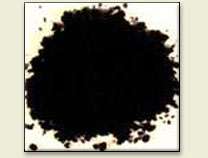
The ground pigment:
Pile of ground Indigo
 Sections: