

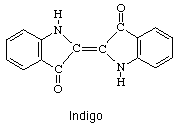
About the chemical structure:
| Chemical name: | Indigotin (2,2'-Biindolinyliden-3,3'-dion) |
| Formula: |
C16H10 N2O2 |
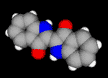
| 3D model: |
grey = carbon, red = oxygen, white = hydrogen, blue = nitrogen |
| Crystal system: | rhombic |
| Refractive index: | n/a |
Color:
| Color Index (C.I.) | NB 1 |
How can you identify Indigo?
Imaging:
UVF: no
FCIR: red
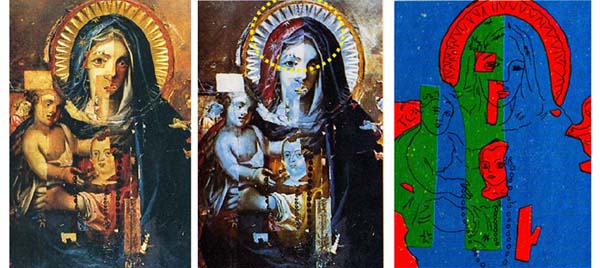
Maestro della Maddalena, XIII century, Italy
Left, visible image. Middle, IRFC image. Right, restoration mapping: blue, original XIII century, red XVIII restoration, blue XIX restoration.
The blue bonnet of the Virgin shows up in red (left side) and black (right side) in the IRFC. Indeed, the left was restored with indago in the XVIII century, while the right side was repainted in prussian blue.
OM: Deep blue, regular and slightly rounded particles. All particles are very fine. Some deep blue needle shaped particles often seen.
Particles are difficult to analyze and almost no distinct particles can be seen at magnification. Particles are usually between 1-10μm in size.
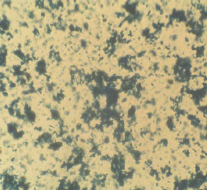
Microscopic appearance at x500 mag
Analytics:
It's identified by means of FTIR and Raman.
Raman spectra: ColoRaman
FTIR spectra: IRUG
Usage and handling:
| Permanence: | Toxicity: |
|---|---|
Lighfast: poor. Degradation processes: it has high tinting strength but may fade rapidly when exposed to strong sunlight. It is best used full strength and protected from ultraviolet light beneath a UV-protecting varnish or glass. |
non toxic. MSDS: Kremer |
Literature:
Seefelder, M., Indigo - Kultur, Wissenschaft und Technik, Ecomed Verlag, Landsberg 1994
Artists’ Pigments. A Handbook of Their History and Characteristics, Vol. 3: E.W. Fitzhugh (Ed.) Oxford University Press 1997, p.81-107.
Indigo (at Pigmentlexikon by Th. Seilnacht)
 Sections: