Azurite
 Cerulean Blue
 Cobalt blue
 Egyptian blue
 Indigo
 Prussian blue
 Smalt
Smalt Ultramarine
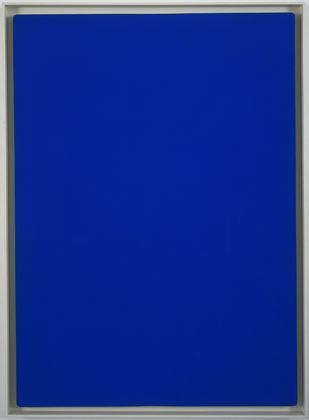
A perfect blue. Yves Klein (1928-1962), Blue Monochrome, 1961, The Sidney and Harriet Janis Collection. Monochrome painting was defined by Yves Klein as an "open window to freedom as the possibility of being immersed in the immeasurable existence of color." He synthesized his own blue, International Klein Blue and used this pigment in order to evoke his boundlessness vision of the world, being blue the color of infinity.
Symbolism of the Color Blue
Blue is the color of sky and water. From the time of the ancient Egyptians, the blue depths of water personified the female principle, while sky blue was associated with the male principle. Blue is the color of all heavenly gods and stands for distance, for the divine, and for the spiritual.
Blue is also the symbol of fidelity. Blue flowers, such as forget-me-nots and violets, symbolize faithfulness. According to an old English custom, a bride wears blue ribbons on her wedding gown and a blue sapphire in her wedding ring. Tiny flowers of blue speedwell are part of the wedding bouquet.
In the English language, blue sometimes refers to sadness. The phrase "feeling blue" is linked to a custom amongst old sailing ships. If a ship loses her captain, she would fly blue flags when returning to home port.
In German, to be "blue" (blau sein) is to be drunk. This derives from the ancient use of urine (which is produced copiously by the human body after drinking alcohol) in dyeing cloth blue with woad or indigo. However, the color blue also had other associations in Germany. The Blue Flower was the symbol of German 19th century Romanticism, thanks to the novel fragment Heinrich von Ofterdingen, by the German poet Novalis.
Short History of Blue Pigments
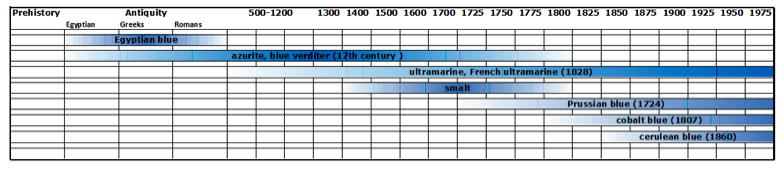
The first blue pigment was azurite, a natural mineral. Soon thereafter, Egyptians manufactured Egyptian blue, which quickly spread throughout the ancient world. During the Middle Ages, the recipe for Egyptian blue was lost, so azurite and expensive ultramarine from Afghanistan were the only sources of blue available. In the 15th century, smalt, a finely ground blue glass, came into use for painting. The first pigment produced due to the advancement of modern chemistry was a blue, Prussian blue, which was soon followed by cobalt blue and cerulean blue.
Blue is a primary color in painting, with the secondary color orange as its complement. It is in the visible spectrum at wavelengths in the range of 440–490 nm.
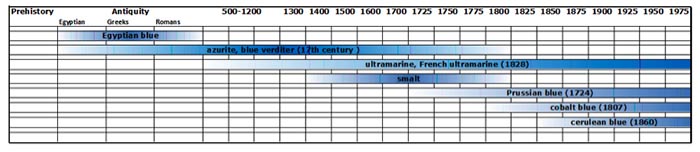
Timeline of blue pigments.
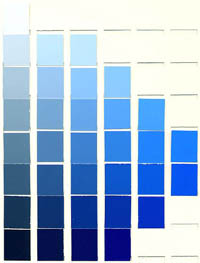
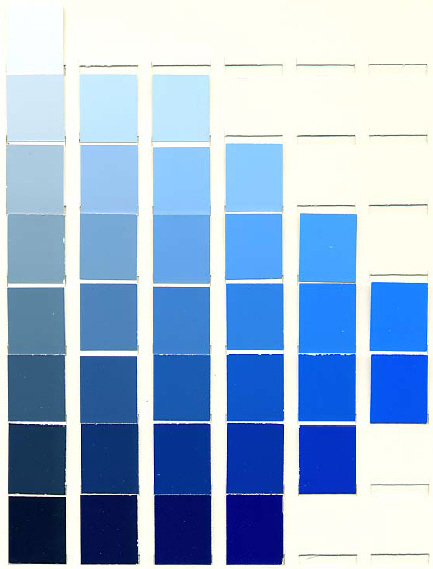
Munsell chips of hue 5PB at eight levels of lightness and six levels of chroma.
|
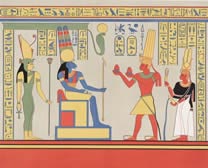
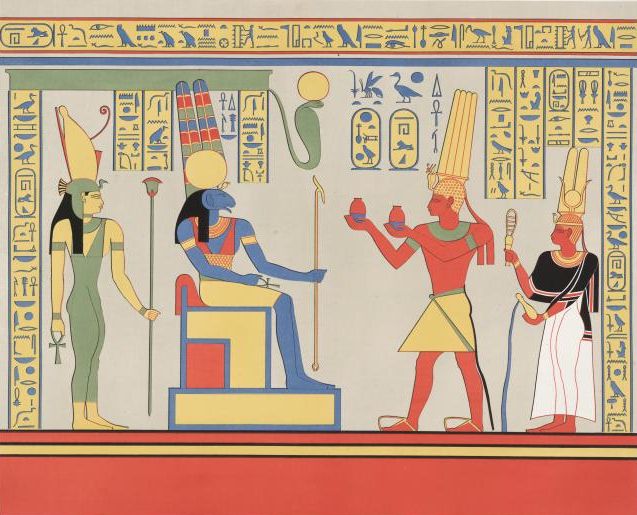
A blue god appears in this copy of Pharaoh and a Temple Chantress present offerings to Amon, by Ernst Weidenbach, 1845. The skin of the Egyptian god Amon was rendered blue. Originally, he was the deification of the concept of air, one of the four fundamental concepts of the primordial universe. Amon means “the hidden one,” as the air and the wind cannot seen by the eyes. He was originally depicted as a frog-headed god and his invisibility was represented by the color blue - the color of the sky |
Charlemagne, missal, circa 15th century. In early medieval Europe, blue was a royal and aristocratic color, as blue dyes were rare and expensive. Due to the rarity of blue dyes made from woad, and also because Tyrian purple had gone out of use in Western Europe after the collapse of the Roman Empire, Europeans’ idea of royal color shifted from Tyrian purple towards blue. The working class wore mainly green and brown. |
|
Blue was commonly used in art depicting the Virgin Mary. This is an anonymous panel painting of the Annunciation, in egg tempera, from 1490. The blue color in Mary’s mantle links heaven and earth, the divine and the mundane, and also symbolizes purity. |
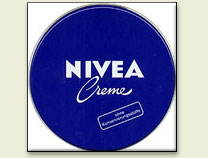
Blue has a calming effect. This container of Nivea skin cream features a synthetic ultramarine blue. Blue is often associated with cleanliness and freshness in household products. On drinks, blue labels are associated with coolness and lightness. Blue also invokes dreamlike states. Blue is the color of the heart and generally has a positive connotation when used for commercial or business purposes. Several companies have blue logos, including ARAL, Deutsche Bank, Levi, and Nivea. |