

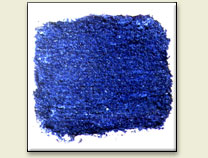
Brief description of Smalt:
It's a ground blue potassium glass containing cobalt used among the 15th and the 18th centuries. In Europe the use of smalt as an artist's pigment was widespread certainly as early as the late sixteenth century. Smalt was popular because of its low cost and its manufacture became a specialty of the Dutch and Flemish in the 17th century. Smalt is a very good dryer and was used for this purpose and also to give bulk to thick glazes containing lake pigments which are poor dryers.
Names for Smalt:
| Alternative names: | starch blue | ||||||
| Word origin: | The name "Smalt" comes from Germanic origin. | ||||||
| Non-English names: |
|
||||||
| Origin: | artificial | ||||||
| Chemical name: | potassium glass containing cobalt |
Example of use by artists:
Painting with crashed glass

Hans Holbein the Younger, Sir William Butts, 1540-1543, National Portrait Gallery, London.
Renaissance artists used ground cobalt containing glass, smalt, to add vibrancy to their paintings. A portrait of Sir William Butts by Hans Holbein the Younger (1497-1543), is among the earliest paintings in which smalt has been found as a pigment.
(intro) - Azurite - Cerulean Blue - Cobalt blue - Egyptian blue - Prussian blue - Smalt - Ultramarine
 Sections: