
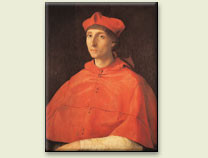
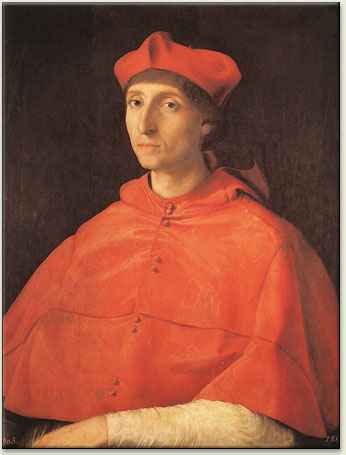
The Emperor alone was allowed to wear purple robes during Roman times. Senators had to make do with purple ribbons on their togas. German emperors continued the tradition of wearing purple robes as a symbol of power and they were joined by the cardinals in 1468.
Strict clothing regulations were enforced in Europe up to the times of the French Revolution. Pure colors were reserved exclusively for the rich nobility. Preparation of pure bright colors from natural sources was very tedious. Development of complex technical processes such as extracting of carmine from the cochineal insects or red dyes from the madder plant made it finally possible to achieve bright red tones. Wearing red coats was the exclusive right of the nobility in medieval times and the red robes of kings, cardinals, judges and executioners announced their power over life and death.
Advent of modern dyeing procedures and deteriorating power of the nobility led to the demise of red as a symbol of power. Red military uniforms became common up to the 19th century, Today’s Judges on the Supreme Court in Germany wear red robes.
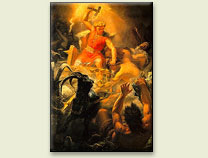
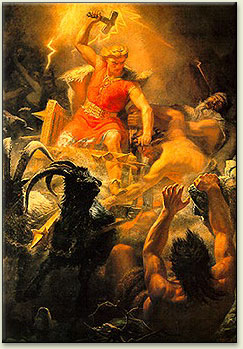
The Germanic god of thunder Thor had red hair, and lightning was believed to originate from blowing into his red beard. Here, Thor is fighting the giants, as painted by a Swedish artist, M.E. Winge in 1872.
Negative connotation of red
Hair of Virgin Mary and the robes of Angels were depicted red in medieval paintings. The definitely positive connotation of the color red which originated with the neolithic hunter peoples and continued with the ancient Germans starts to change around 1500. The Germanic god Thor (other names include, Ása-Thór, Donar, Donner, Thór, Thunder, Tor) had red hair. More about Thor from Ashliman at University of Pittsburg. Red animals such as the robin, the fox and the squirel were Thor’s sacred creatures. Beard and eyes of Wotan, the Germanic god of hunt, were fiery red too. Advent of Christianity diminished the power of these two Germanic gods. They were transformed into the devil with his red hair and red beard. Red haired women were reputed to be witches and whores and the poppy became the devil’s flower. Sexuality which was also associated with red was demonized in Christianity. Mary’s hair became blonde. Old sayings discriminated people with red hair or red beard: "Red hair, evil hair" and "Red beard - devil’s way". Such prejudices still prevail in some rural areas of Europe.
The effect of the color red used to play an important role in politics. Red is the most frequently used color for national flags, mostly due to its excellent visibility. Red became the symbol of communism and socialism during the Russian Revolution in 1907. Red color had usually a positive connotation in cold countries like Russia throughout history. Red Army’s alternative name was "Glorious Army" and Russian words for red (krassnyj) and beautiful (krassivyj) are very similiar. Western cultures frowned upon red color in its political sense. "Better dead than red" was popular in cold war days in the US. Black swastika of the National Socialists was painted on red background to suggest association with the working classes.

The red of Coca-Cola dennotes power and high efficiency. Use of red in advertising is less frequent than blue due to its obtrussiveness.
Effects of red color
Infrared radiation is used for healing purposes due to its warming and pleasant effect. The general effect of red is stimulating and appetizing. Mere perception of red color enhances the human metabolism by 13,4 % (source: Theroux 1998). It is the favourite color of children. On the other side aggression and violence can be triggered of by red color. Barnett Newman’s huge red canvasses were attacked and damaged by the viewers. Spanish bullfighters bait the bulls with red cloth - unnecessarily though - bulls are color-blind and would react to any color whatsoever. The important factor is the mere movement of the bullfighter. Red is the color of emotional outbursts: Shame or anger colors our face red. Loosing control lets one to "see red".
Red traffic lights and brake lights announce danger. Animals use red color to recognize its own kind, to announce the mating season or to issue a warning. Red in advertising is used to evoke erotic feelings (red lips, red cars, etc.).
(main yellows page) - vermilion - red lead - Madder lake (alizarine) - realgar - Red ochre