- Choose:
 Bone black
 Carbon black
From prehistoric times to the present day, artists typically use carbon black charcoal to sketch their initial designs before starting a painting. These preliminary charcoal sketches are often used to outline the composition and determine the relative values of the objects portrayed, thus forming an important part of the art-making process. From the charcoal bison drawings in the caves of Altamira, to the charcoal studies created during Life Drawing classes at art schools throughout the world, the black marks made by charcoal contain a particular sense of freshness and immediacy that isn’t found in colored artwork.
Symbolism of the Color Black
The color black represents opposing ideas: authority and humility, rebellion and conformity, and wealth and poverty. Black also signifies absence, modernity, power, elegance, professionalism, mystery, evil, traditionalism, and sorrow.
Black also implies submission. Priests wear black to signify submission to God.
In Western countries, black is the color of mourning, while in many African countries white is the color worn during funerals.
In Japanese culture, black means experience, as opposed to white, which symbolizes naiveté. Thus the black belt is a mark of achievement and seniority in many martial arts, whereas a white belt is worn by beginners.
The Russian painter and art theorist Wassily Kandinsky interprets the color black as: “a totally dead silence... A silence with no possibilities, has the inner harmony of black. In music it is represented by one of those profound and final pauses, after which any continuation of the melody seems the dawn of another world. Black is something burnt out, like the ashes of a funeral pyre, something motionless like a corpse. The silence of black is the silence of death. Outwardly black is the color with least harmony of all, a kind of neutral background against which the minute shades of other colors stand clearly forward. It differs from white in this also, for with white nearly every color is in discord, or even mute altogether.”
Short History of Black Pigments
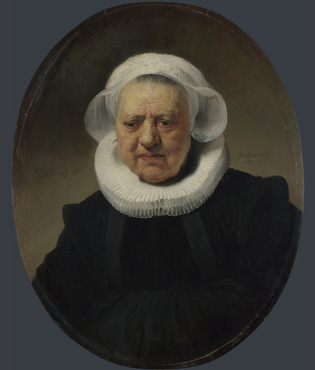
Carbon black was the first black. This dull black is the easiest to manufacture because it is made of charcoal. Another black is vine black, which is traditionally made by charring desiccated grape vines and stems, which produce beautiful bluish blacks. Bone black, made of burnt bones from prehistoric times, is the deepest available black. Rembrandt used bone black for the black clothing worn by his sitters in order to distinguish them from the already dark night surroundings.
|
Timeline of black pigments |
|
Black has been a fashionable color throughout history. For instance, a black tie dinner is very formal and elegant. Wearing black is a current fashion trend because it is believed to make people appear thinner. Black was fashionable in the Medieval era also; it became the habit of courtiers and a symbol of luxury as clearly shown in this portrait of a youth in front of a white curtain, painted by Lorenzo Lotto in 1508. |
|
Rembrandt, Portrait of Aechje Claesdr. 1634, Rembrandt loved blacks. His sitters’ black clothes called for the most intense black pigment. Therefore, bone black is found everywhere in Rembrandt’s paintings, but is always mixed with other pigments and/or lakes. There are just a couple of exceptions. One case is the portrait of Aechje Claesdr (1634, The National Gallery, London). Rembrandt used brushstrokes of pure bone black for the darkest parts of the clothing. |
|
Chinese ink, known for the rich depth of its blackness, is traditionally made from soot mixed with animal glue. The most highly-regarded Chinese ink paintings are monochromatic because they are painted using a single color - black. The values are therefore created by varying the amount of water that is added to dilute the black, as well as altering the strength or lightness of the brushstroke upon the paper. Colors were considered vulgar in the Tang dynasty because, in the right hands, black ink was fully capable of expressing the artist’s vision. Chinese ink is made from a mixture of lampblack, carbon black, and bone black pigment ground together with hide glue. |