
Bellini painted his backgrounds first, leaving gaps for the trees and figures, as seen in the X-rays. The gaps were filled in later.
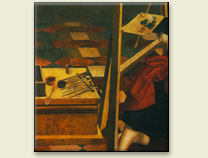
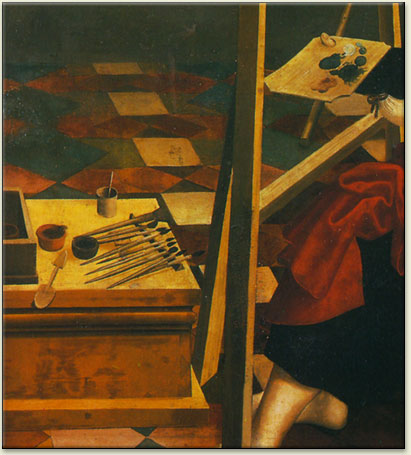
Paint brushes were made with hog's-bristle or miniver (squirrel fur). Paintings always consist of many layers of paint, as seen in the cross-section. Colors can be subtly modulated by applying tinted glazes. A glaze is a very thin oily paint that is transparent, enhancing the colors below. In contrast, opaque pigments would block the layers underneath.
Bellini methodically built up layers of paint, using thin layers that were few number and in a predictable sequence. In contrast, Titian is reported to have used "as many as 20 glazes to capture the appearance of fabrics and human skin."