


A page from the "Causes of Color" exhibit...
Legends and myths of the aurora

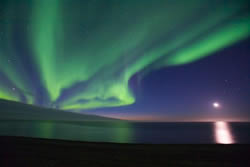
The aurora is both beautiful and slightly uncanny in appearance, and has accordingly spawned myriad legends and myths.
Like the magnetic fields that inspire them, the beliefs surrounding auroras are polarized between positive and negative associations, as precursors of royal births on one hand, and of war and famine on the other. The aurora has fascinated onlookers for millennia.
Folklore of the aurora
The oldest descriptions of the aurora are from the Mediterranean countries and from ancient China. At most, people in these temperate regions would have seen the aurora only once or twice in their lives.
In the 6th century BC, Ezekiel, a prophet-priest of ancient Israel, saw the aurora and wrote that "…a whirlwind came out of the north, a great cloud, and a fire infolding itself, and a brightness was about it, and out of the midst thereof as the color of amber, out of the midst of the fire." (Ezekiel 1:4). In 344 BC, the Greek philosopher Aristotle observed the aurora and compared its light with flames from known sources on Earth. The Romans called them "chasmata," the mouths of celestial caves. Today, different locations that share the same auroral frequency are known as isochasms.
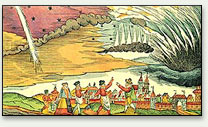
Northern lights above Nürnberg in Germany in 1591. Because auroras rarely appear in Western Europe, people are shaken by the sight. |
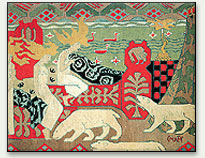
This tapestry, entitled "Wooers" or "Daughters of the Northern Lights," was clearly inspired by Norse mythology, in which the aurora was perceived as feminine. |
The early dragon legends of China and Europe are said to have originated from the aurora. The Aurora Australis, or Southern Lights, were understood by the aboriginal Australians to be the dancing of the gods. The aboriginals of Scandinavia, the Sámi, feared and respected the aurora, and placed auroral symbols on their magic drums, believing that the Northern Lights had supernatural powers to resolve conflicts. In the British Isles, the Northern Lights were known as the "nimble men" or the "merry dancers," names belying the fact that auroras were seen as clans at war, and the red light as blood spilt in violent battle. In Estonia, legends connect the aurora to whales playing – and one even involves a crocodile.
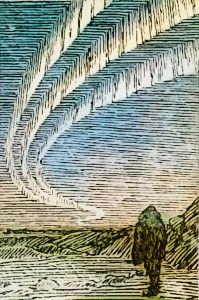
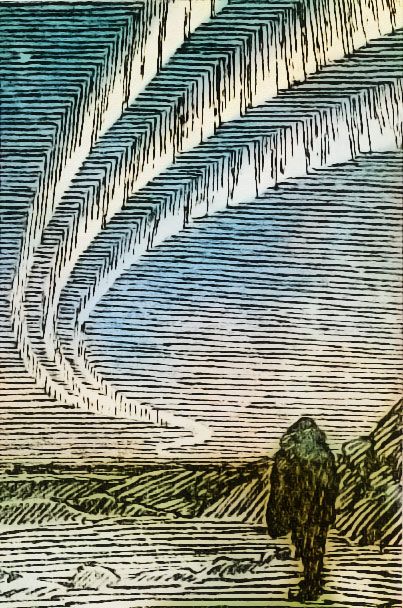
In Norse mythology, a bridge named Bifrost connected Earth and Åsgard, the home of gods. It most likely was modeled after rainbows or the Northern Lights, and was guarded by the god Heimdal. Scandinavian popular belief linked the aurora to dead women, especially to dead virgins. The Finnish name "revontulet" referred to the mythical firefoxes of Lapland, brushing up sparks with their tails. Some attributed the aurora to reflections from the shields of the Valkyries, warlike women chosen by Odin to guide fallen warriors to Valhalla. Others believed their glow came from the beautiful Viking goddess Freja, riding horseback.
Some native North Americans believed that if you whistled at the aurora, it would sweep down and take you from the earth; by clapping your hands you could force it to retreat. The Algonquin believed the light reflected fires made by the creator, Nanahbozho, to remind his people that he remembered them. Many myths involve dead warriors, sometimes enemies, and are again strongly associated with war.
In Greenland, the aurora was seen as the highest level in the afterlife, with good weather and easy hunting. The moving lights were thought to be spirits playing ball games with the skull of a walrus. The Nunivak islanders had the opposite belief – that the skull was human, and that the ball players were the spirits of walruses. Another Greenland belief was that the ball players were the souls of young babies, playing with their afterbirths. During the Klondike Gold Rush, the Northern Lights were said to reflect a great Mother Lode of gold.
Up until the Enlightenment of the 18th century, the Northern Lights often were viewed with fear or reverence and were related to contemporary concepts of heaven and hell. Many still claim that an aurora is audible as hissing and cracking, although there is no scientific evidence to support this.
Even in modern times, there have misconceptions as to the origins of the aurora. For example, some have thought that auroras are related to the reflections of icebergs. Auroral sightings have been associated with bad omens, such as the bombing of Pearl Harbor on December 7, 1941. The eerie presence of auroras still triggers our imaginations into fanciful flights.