

| |

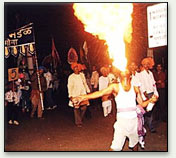
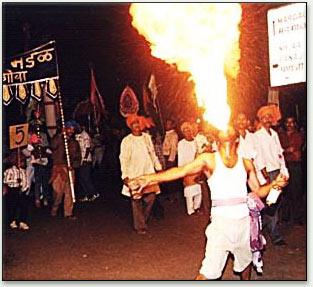
Fire Eater at the Shigmo festival in Madkai Romtamell, India.
 |
Our colloquial usage of "red hot," "white hot," and so on, is part of the color sequence black, red, orange, yellow, white, and bluish white, seen as an object is heated to successively higher temperatures. The light produced consists of photons emitted when atoms and molecules release part of their thermal vibration energy.
Light is often said to have a color temperature. What this means is that the color of the light is the color of light radiated by a so-called black body (an idealized radiating object) which is at that temperature. This can easily be seen to apply to a photographic lamp or even the sun, but it can be applied to any source of light. color temperature is measured in Kelvins and the higher the color temperature the bluer the light. In practice the actual temperature is not the same as the color temperature.
Here are the color tempertures of some common light sources:
approx
20,000 K |
 |
6,500 K |
 |
5,400 K |
 |
3,780 K |
 |
3,400 K |
 |
2,865 K |
 |
1,930 K |
| Open sky |
Overcast sky |
Direct sunlight |
Carbon arc light |
Photoflood bulb |
100 Watt tungsten bulb |
Candle flame |
|

Candle flames on earth (left) have several different temperatures within the flame; on a space station (right), there is no buoyant convection, and the flame burns slower and hotter.

|
|
| |
Flames
Color tells us about the temperature of a candle flame. The outer core of the candle flame is light blue -- 1670 K (1400 °C). That is the hottest part of the flame. The color inside the flame becomes yellow, orange and finally red. The further you reach to the center of the flame, the lower the temperature will be. The red portion is around 1070 K (800 °C). The reason there is this variation in a candle's flame color is because air convection pulls the warmer gasses upwards.
Candle flames behave differently in outer space (microgravity) than they do on Earth. The primary reason for this difference is that microgravity provides an environment that lacks buoyant convection, which normally plays an important role in maintaining and shaping a flame on Earth. In Earth's gravity, buoyant convection develops when hot, less dense combustion products rise. The flow that results draws cooler surrounding air to the base of the flame, supplying it with the oxidizer (in this case, oxygen) that the flame requires to maintain itself. Combustion products (carbon dioxide, water vapor, and soot) are carried away from the flame by the same convective flow, which is the dominant transport mechanism in the flame.
In microgravity, however, the process is not the same; there is no buoyant convection, and the transport of combustion products and oxygen occurs by the much slower process of molecular diffusion. This diffusion occurs when there is a high concentration of combustion products and a low concentration of oxygen close to the flame and a high concentration of oxygen farther away from the flame. The combustion products migrate away from the flame and the oxygen migrates toward the flame. The diffusive transport rates in microgravity are much lower than the transport rates due to natural convection in Earth's gravity. As a result, the flame will often appear to burn less vigorously than a flame on Earth, and it will assume a spherical shape that diffuses equally in all directions, rather than the more elongated shape that is characteristic of flames in Earth's gravity.
Blackbodies
|
|
Blackbody curves for different temperatures, also showing the displacement of the maximum according to Wien's law.
 |
|

A blacksmith removing a red-hot
heated iron from a forge. |
|
At any given temperature there is a peak in the emission of radiation, as can be seen in these curves, with a shift of the peak of the emission curve toward shorter wavelength (higher energy) with increasing temperature (Wien's law). Max Planck found in 1900 that the quantization of energy was necessary to explain the idealized "black-body" radiation, thus leading to the modern quantum theory.
The color of incandescence is used in radiation pyrometers to measure temperature. Illumination sources from the primitive candle through limelight, arc lamps, and the modem incandescent-filament lamps and flash bulbs all utilize incandescence; usually the aim is to avoid color. Part of the light from pyrotechnic devices (e.g., fireworks) is also derived from chemical- reaction-produced incandescence.
The sun
| |

|
The emission from the 5700°C temperature of the surface of the sun gives us our definition of white; its peak near 550 nm (2.25 eV) is mirrored in the maximum sensitivity of our eyes in the same region, reflecting our evolution in the vicinity of the sun. The surface of the Sun, called the photosphere, is at a temperature of about 5800 K.
 |
| |
|
Visible light from the sun begins as high energy gamma rays. The Sun's energy output (3.86e33 ergs/second or 386 billion billion megawatts) is produced by nuclear fusion reactions. Each second about 700,000,000 tons of hydrogen are converted to about 695,000,000 tons of helium and 5,000,000 tons (=3.86e33 ergs) of energy in the form of gamma rays. As it travels out toward the surface, the energy is continuously absorbed and re-emitted at lower and lower temperatures so that by the time it reaches the surface, it is primarily visible light. For the last 20% of the way to the surface the energy is carried more by convection than by radiation.
In addition to heat and light, the Sun also emits a low density stream of charged particles (mostly electrons and protons) known as the solar wind which propagates throughout the solar system at about 450 km/sec. The solar wind and the much higher energy particles ejected by solar flares can have dramatic effects on the Earth ranging from power line surges to radio interference to the beautiful aurora borealis.
< Previous Next >