



A page from the "Causes of Color" exhibit...
Why are beetle shells colored? (interference)

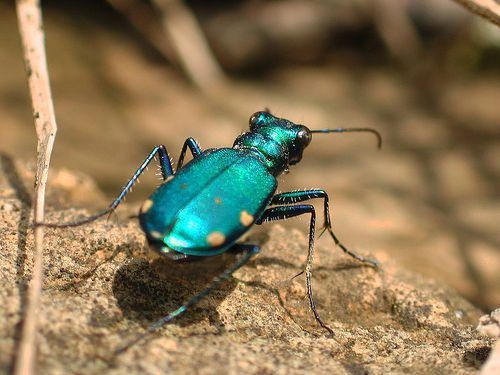
Most insect structural colors are in the green-blue-violet range, but red, gold, and copper colors may also be produced in this way. The shade of color and its intensity are determined by several factors, including the thickness and spacing of the layers of the scales, or epicuticle, the number of these layers, and the angle of the incoming light.
Although we often think of beetles as garden pests or garden protectors, many cultures use parts of dazzling, colorful beetles as ornamentation for ceremonial costumes and headdresses, as well as in prized jewelry. Just as structural color is responsible for the beautiful shimmering blue of neotropical Morpho butterflies, it is also responsible for the glistening iridescent colors of many tropical beetles.
The epicuticle, or outermost surface, of iridescent beetles is made of many stacks of slanting, plate-like layers, which are oriented in different directions. These layers bend, and then reflect the incoming light in the same way as the ridges of iridescent butterfly and moth scales. Similarly, they produce structural colors by interference in the same way as butterfly wings. A layer of pigment below the refractive plates of beetles and the ridges of iridescent butterfly scales enhances the effect of the iridescence. In some species, the epicuticle acts as a reflection diffraction grating to cause iridescence. The exact mechanism of the structural color for many species is an open topic of research.
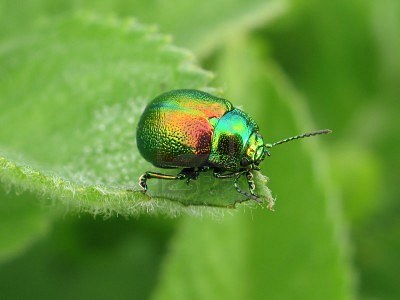
The leafy environment of some beetles is often illuminated by intermittent flashes of sunlight as breezes move through the trees. The glistening surfaces of these beetles blend in well with the beetles’ surroundings.
Why are many tropical beetles iridescent?
Unlike birds, most insects do not use showy color to attract mates; instead, the primarily rely on chemical attraction. It might seem that the colorful appearance of these beetles would advertise their presence to predators; in fact, these creatures are surprisingly well camouflaged.