

A page from the "Causes of Color" exhibit...
Why are rainbows colored?


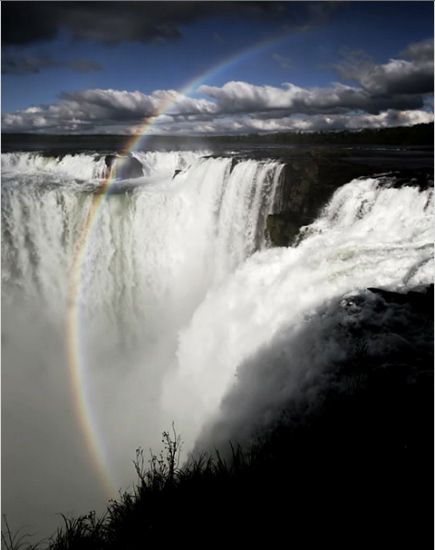
Rainbows can be seen in the spray of a waterfall. Ideal conditions for rainbows are sunlight and water droplets, usually as rain, but also in fine spray.
How is a rainbow formed?
The mechanics of rainbows have been studied since ancient times. The Greek philosophers were aware of the role of reflection in forming a rainbow, and had some understanding of the role of refraction. In the 13th century, scientists produced theories on rainbow formation, and in the 17th century, Rene Descartes sketched out the conditions required to observe a rainbow.
We see rainbows because of the geometry of raindrops. When the sun shines from behind us into the rain, incident rays of light enter the drop and are refracted inwards. They are reflected from the back surface of the raindrop, and refracted again as they exit the raindrop and return to our eyes. Refraction is responsible for splitting the sunlight into its component colors.
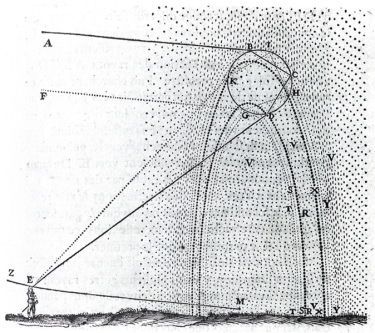
Descartes’ well-known sketch describes the conditions required to observe a rainbow. The sun is directly behind him, and the light reflected from the raindrops ahead of him concentrates between approximately 40.6° and 42.4°, centered on the point where the shadow of his head would be.
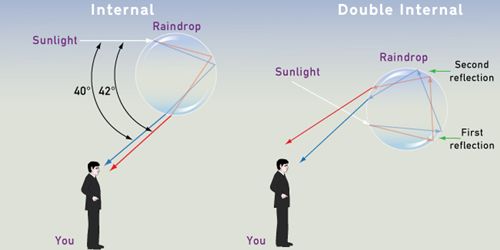
You perceive a rainbow from a particular position; "your" rainbow will alter as you move and will differ from others’ perceptions. Because the light from any single drop is dispersed, only one ray of a particular color reaches your eye. The violet band that you see leaves the corresponding raindrops at about 40.6°, and the red band that you see leaves its corresponding raindrops at 42.4°, so the red light is from raindrops higher in the sky relative to your eye.
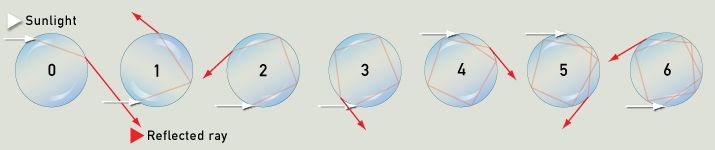
Above, compare the angles from internal and double-internal reflections. There are triple- and quadruple- internal reflections as well. See up to 6 internal reflections below.
Secondary rainbows are formed by double internal reflection. Light is reflected twice from the inner surface of the raindrop before leaving the raindrop. The light is concentrated between approximately 50.4° and 53.6°, forming a secondary rainbow above the primary rainbow.
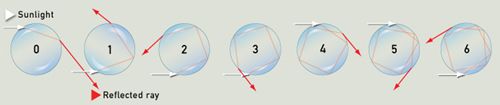
Explore for yourself the main rains through a raindrop. Notice how short and long wavelengths have slighty different angles. The primary output angle is from one reflection.
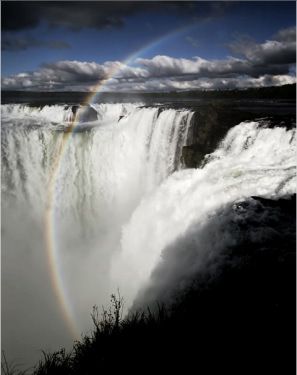
If we were able to see an entire rainbow (for example from a plane) it would form a full circle. This rainbow over the Iguazu Falls illustrates this with its extended arc.
The size of the raindrops does not affect the geometry of the rainbow, although very tiny drops, such as those in fog or mist, reduce the effect. In this case, the effect of scattering overpowers the dispersive refraction effect. A "fogbow" has the arc of a rainbow, but appears as a bright white bow without spectral colors.
The angle of the sun does affect the rainbow we see. Once the sun is higher than 42°, the rainbow arc slips below the horizon. As the sun approaches the horizon, the size of the visible arc increases, reaching a full semicircle just before sunset.
Moonbows have been observed, but as our night vision is not sensitive to color, they appear white rather than colored.
Secondary rainbows and supernumerary rainbows

The Blind Girl, by John Everett Millais, expresses the pathos of this figure, unaware of the splendor surrounding her. The artist has taken some liberties with the double rainbow here; the dramatic dark sky below the rainbow does not occur in nature.
If one rainbow is beautiful, a double rainbow is breathtaking. In fact, is possible for sunlight to be reflected three or more times in one raindrop, but third order rainbows cannot be seen. They form so close to the sun that its brightness overpowers them.
In the laboratory, it is possible to recreate multiple rainbows formed by multiple internal reflections. A spherical flask of water simulates the raindrop.
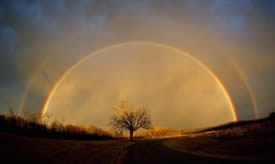
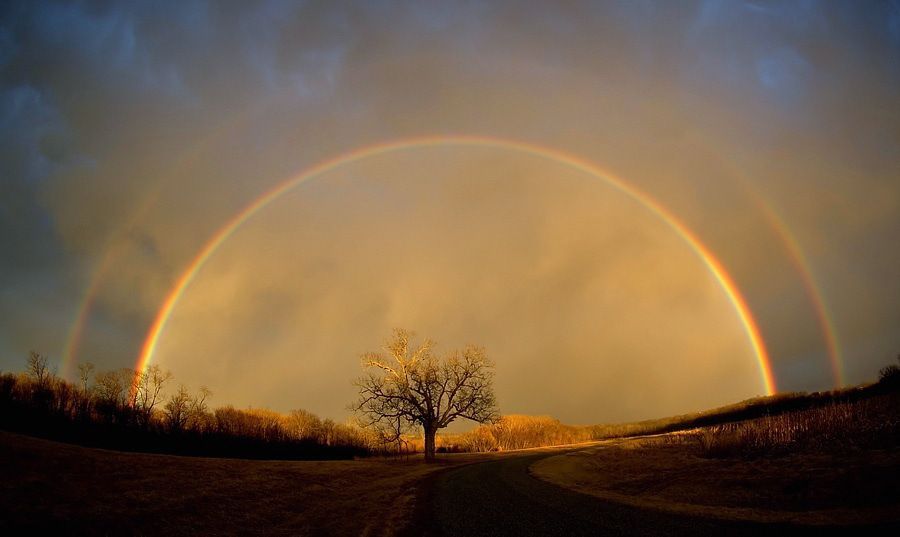
In a double rainbow, raindrops reflect the sun’s light noticeably inward from the rainbow arc, and correspondingly out of the secondary bow, so that the dark band is seen between the bows. This effect, called Alexander’s band, was first described by the Greek philosopher Alexander of Aphrodisias in the 3rd century. The sky below the primary (lower) rainbow, and above the secondary (higher) bow, is brighter as a result.
A supernumerary rainbow forms additional bands on the inner arc of the primary rainbow, or very occasionally on the outer arc of the secondary rainbow. These bands, which usually appear in pastel colors, are caused by the interference of light waves.
|
This photograph illustrates the actual appearance of a double rainbow, with the bright area below the primary bow and the dark Alexander band between the bows. The colors of the bright primary rainbow (lower) run from violet on the inside to red on the outside. In the secondary (higher) rainbow the color sequence is reversed, with red on the inside and violet on the outside. |
The primary rainbow is brightest, with red at the top and violet at the bottom. The supernumerary bands appear up against the violet band, in pastel shades that do not follow the usual pattern of spectral color. These bands are caused by the interference of light waves, providing evidence for the wave nature of light. |