
Why are things colored?
|

|
|
|
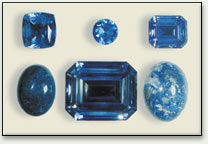
Six gemstones, six causes of color
Clockwise from top left:
(1) Maxixe-type beryl, radiation-induced color center. (2) Round blue spinel, ligand-field color from a cobalt impurity. (3) Spinel "doublet, "colorless spinel containing a layer of organic dye. (4) Oval lapis lazuli, S3- anion-anion charge transfer. (5) blue sapphire, Fe-Ti intervalence charge transfer. (6) Oval shattuckite, cobalt compound.
Scale: the largest stone is 2 cm across.
|
|
Why is the sky blue? Why is fire yellow? What about flamingos or emeralds?
Scholars have learned that all the colors in the universe originate from a mere fifteen fundamental physical causes. These causes appear over and over, lending color to the world around us. Some common causes seem logical -- for example, both light bulbs and candles are colored by incandescence -- and others are surprising -- did you know that the colors of peacock feathers and bubbles are both caused by interference?
These fifteen causes of color derived from a variety of physical and chemical mechanisms are summarized in five groups in this exhibit. Vibrations and simple excitations explain the colors of incandescence (e.g., flames), gas excitations (neon tube, aurora), and vibrations and rotations (blue ice and water). Ligand-field-effect colors are seen in transition-metal compounds (turquoise, chrome-oxide green) and impurities (ruby, emerald). Molecular orbitals explain the colors of organic compounds (indigo, chlorophyll) and charge-transfer compounds (blue sapphire, lapis lazuli). Energy bands are involved in the colors of metals and alloys (gold, brass), of semiconductors (cadmium yellow, vermilion), doped semiconductors (blue and yellow diamond), and color centers (amethyst, topaz). Geometrical and physical optics are involved in the colors derived from dispersive refraction (rainbow, green flash), scattering (blue sky, blue eyes, red sunset), interference (soap bubbles, iridescent beetles), and diffraction (the corona aureole, opal).
< Previous Next >